
Simple integration with any VRF or chiller
The IESS Panel, also known as the HTS (Hybrid Thermal Solar) panel, is a solar panel for VRF, inverter AC and chiller systems. It doesn't generate electricity. Instead it adds solar heat to your AC's refrigerant, so the system runs on electricity plus solar energy and uses up to 40% less power.
Copper pipes in, copper pipes out
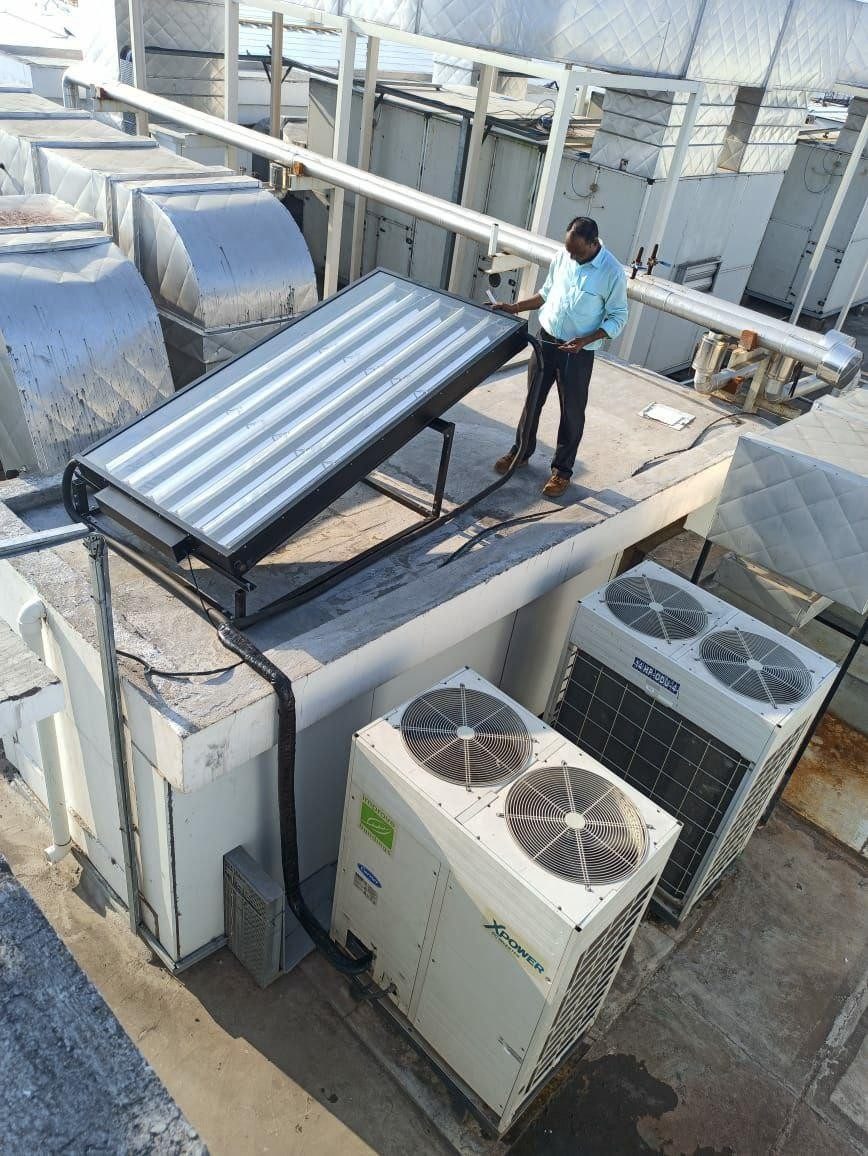
The IESS Panel connects to the VRF outdoor unit or chiller plant with copper pipes only. It sits in the refrigeration cycle between the compressor and the condenser. It works with new installations and retrofits alike.
A typical installation needs some copper piping, four copper joints and one electrical connection. The panel's controller works on its own and makes no changes to your AC manufacturer's control system.
How the sun does part of the compressor's work
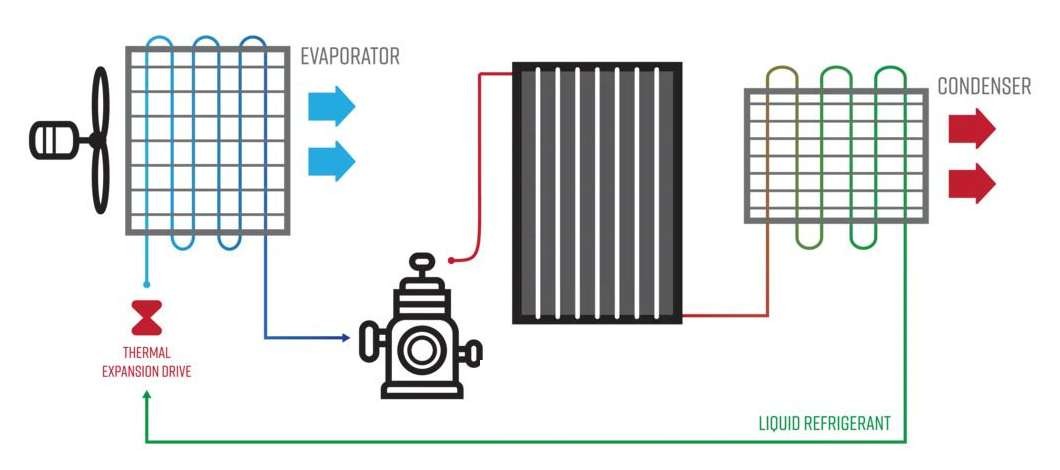
Hot refrigerant gas leaves the compressor for the rooftop panel.
Sun-tracking reflectors add heat and pressure.
The gas returns to the condenser.
The compressor slows down, using up to 40% less power.
Smart, sun-tracking and self-regulating
In a closed refrigerant loop, pressure and heat are linked. The IESS Panel uses this to add solar heat, and only as much as the system can safely use.
Tracking parabolic reflectors
An array of parabolic aluminium reflectors concentrates sunlight onto the copper manifold. A photo-sensing tracker and stepper motors keep the reflectors facing the sun.
Intelligent controller
A dedicated controller watches the refrigerant temperature. It adds solar heat gradually, and turns the reflectors away from the sun if the gas gets too hot.
Your AC's logic stays in charge
The compressor's speed is still set by the AC's own logic based on cooling demand. With the sun supplying part of the energy, it simply needs to work less.
Selective-coated copper manifold
The refrigerant runs through copper tubes with a selective absorber coating (absorptivity 0.92–0.96). The coating captures more heat and resists corrosion.
No sun? No problem
At night or on cloudy days the reflectors stay out of circuit. Your AC runs exactly as it did before, with no loss in cooling.
Built for Indian rooftops
A 100% aluminium enclosure and 4 mm hardened tempered glass stand up to Indian summers and monsoons. The panel is rated for a 15-year life.
Conventional VRF vs. IESS-enabled VRF
Conventional VRF
- Works only on electricity
- COP in the range of 3.5–4.5
- Capacity drops sharply in high ambient temperatures
- Needs an oversizing safety factor for peak summer
- Compressor often runs at high load
- 18% GST, no accelerated depreciation
With IESS Panel Recommended
- Works on electricity and solar energy
- COP of 6+, the best in the industry
- No capacity deration, even in peak summer
- Saves capital cost on HVAC sizing
- Compressor runs on partial load, so the AC lasts longer
- 12% GST & accelerated depreciation
Same roof space. About 12× the impact.
Rooftop space is limited, so what matters is how much each square foot saves. Both panels below take up the same 8 × 4 ft (32 sq ft) of roof.
of electricity generated
- Generates electricity for general use
- Needs about 100 sq ft of roof per kW
- Too space-hungry to meet the load of large ACs
- Largely imported
of AC power saved, the output of about 12 PV panels
- Cuts inverter AC electricity use by up to 40%
- Around 1200% more space-efficient
- Extends AC life and lowers maintenance
- Made in India
Tested by a US engineering firm
SunTrac, the US company behind the technology, had its tracking parabolic panel tested by J&J Engineering, a licensed professional engineering firm in Tempe, Arizona. Its engineers measured the refrigerant cycle and compressor power with and without the panel.
- With the panel, the system delivered the same cooling while using 30% less compressor power
- The solar energy the panel added matched the drop in electrical power at the compressor
- The test ran at only 29°C (84°F) outdoors. J&J noted that savings improve in hotter conditions, such as an Indian summer
Source: J&J Engineering report 14-0003, March 2014, with pressure–enthalpy analysis. Available on request.
One panel for every 10 HP, scalable to any project
A single IESS Panel serves 10 HP (7.5 TR / 90,000 BTU) of connected AC capacity. Larger VRF systems and chiller plants use several panels connected together, so the solution scales from one office floor to a whole campus.
One panel takes about 32–40 sq ft of roof. It can go on a flat terrace, or on an MS structure above the outdoor unit when roof space is tight.
Ideal for
- Offices, IT parks & banks
- Factories & industrial plants
- Hospitals & hotels
- Government buildings, courts & PSUs
- Educational institutions & retail outlets
| Collector frame | 100% aluminium enclosure (8011-H14), 8 × 4 ft |
|---|---|
| Cover | Hardened clear glass, 4 mm |
| Capacity | 7.5 TR / 10 HP / 90,000 BTU per panel |
| Weight / size | 86 kg · 100″ × 52″ × 7″ |
| Absorbers | Copper tube ⅝″ & 1⅛″, selective coating (absorptivity 0.92–0.96) |
| Sun tracking | Two shaded phototransistors with a low-voltage 24 V, 1.5 W actuator; tracks east to west and resets each evening |
| Insulation | 9 mm EPDM |
| Controller | 240 V AC 50 Hz, auto-selecting refrigerant type, temperature sensors, IoT error-code monitoring |
| Refrigerants | Works with common VRF and chiller refrigerants, including R410A and R134a |
| Mounting | Adjustable stand; can be raised on an MS structure above the outdoor unit |
| Warranty | 5 years |
| Design life | 15 years |
Ready to specify
- Listed on GeM, with past orders from NTPC, REC, DMRC and others
- Already specified in PWD SOR / DSR items and tenders
- Certified GreenPro (CII-IGBC) and recognised by GRIHA, so it earns green-building points
- Letters from AC manufacturers (LG, Carrier, Toshiba, Daikin, Blue Star, Voltas, Hitachi, Panasonic) available on request
- Detailed test reports, government approval letters and a complete tender booklet available on request
Find out what your system can save
Share your VRF or chiller details and we'll prepare a technical proposal free of charge.